
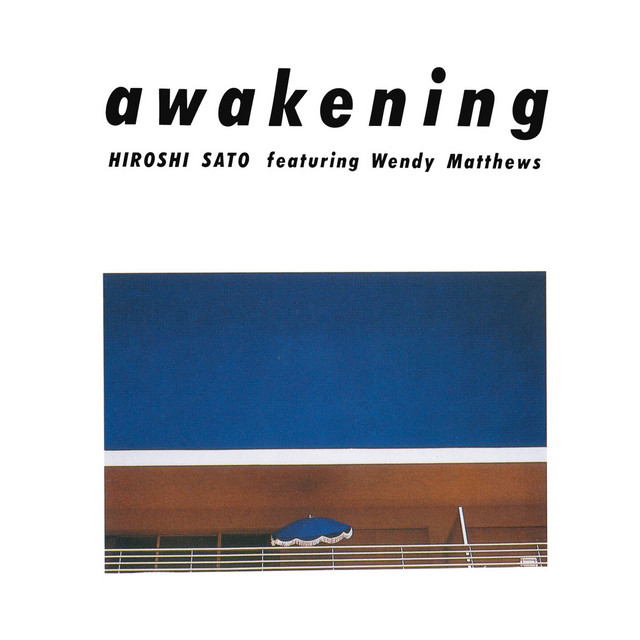
Hiroshi Sato was part of the City Pop scene since its inception, but I never see him attributed with the same prestige or influence as the likes of Tatsuro Yamashita or Toshiki Kadomatsu. That said, his landmark album, 1982's Awakening, is about as classic a City Pop record as one could imagine, but in a far quirkier, organic and individual way than what could be expected from most other artists. Vastly ahead of its time, this work is an unlikely product of Sato's yearning for something he felt Japan could no longer afford him and a magnetism that continually drew him back to his musical roots. To Sato, it really was an awakening, because it represented a renewal of possibility, and the resulting work is one of the finest examples of genre fusion to come out of Japan that decade.
*I maintain that Prince had no place using it in Sign 'O' The Times, feeling more of a convenience in his case, whereas for Hiroshi Sato it feels integral to his overall concept.
- Say Goodbye
- Blue And Moody Music (Wendy's Version)
- Only A Love Affair
- Blue And Moody Music
- Awakening
- It Isn't Easy
- I Can't Wait
- Love And Peace
- You're My Baby
- From Me To You
(Exempt from total score: Awakening (覚醒) )
Average Score: 6.0
Say Goodbye is about as close to a City Pop anthem as you can get, yet its sound actually encroaches more on the contemporary 'future-funk' offshoot from the last decade. Though the staple of funky guitar fills are prevalent, as well as Awakening's signature semi-automated arpeggiated motif, it's the introduction of Sato's robotic vocoder-processed voice and the wobbly low synths that project this song so far into the future. This combination makes for a distorted, submerged-under-water feel that evokes the kind of overproduction that has only really come about since City Pop was rediscovered in the internet age, messing with its bare bones and 'retrofuturising' the music within a new context. Here, the heavy affectation to the tones create a bubble around the relatively simple song, making it the most immersive moment on the record.
Collaborating with Australian singer Wendy Matthews for multiple vocal tracks was a key factor in the album's blanket mood of genre-mashed sophistication. Her clear, high voice performs a careful balancing act with Sato's deep, rich tone, and the whole album feels like the most grown-up of duets. Their two separate versions of Blue And Moody Music act as opposing ends of the electronic-acoustic spectrum - and though both are magnificent, the rendition with Wendy's vocals trumps it for me; the brighter, perkier sound bypasses the literal content of the lyrics and cuts straight to the feeling they're trying to convey. Her voice is an exquisite fit for another highlight, Only A Love Affair, in which she passionately but sagaciously confesses her irrepressible love for someone, as the coolest of electric pianos tinkles around her vocals. The song is restrained, chic and perhaps the most refined on the album, whilst still feeling very much part of the same world as the thick, competing layers of Say Goodbye.
Though it's true that I applaud how effectively Sato was able to marry acoustic jazz with pioneering electronica, I will say that every track errs one way more than the other, and it is unfortunately those jazzier influenced ballads that I feel are weaker. They are undoubtedly beautiful in their moodiness, but that moodiness is a double-edged sword; at worst, they're sluggish, dense and drowsy. It Isn't Easy, when isolated, manages to ride the soul to a greater degree of success than the rest, but is mildly hampered by its positioning directly after the equally-slowly-paced I Can't Wait. Furthermore, its aloofly virtuoso piano solo is offset by the overarching prevalence of a particularly lumpy pentatonic scale motif, feeling a little too remedial of a focus when in such a high class of music production.

The aforementioned envelope pushing is perhaps the reason why I don't harbour as much love for Sato's subsequent works, which are far more synth-heavy and clumsy, despite his ever-prevalent skilfulness as a programmer and producer. Awakening marks an interesting juncture in his career, freshly back from America (a point of significance for many City Pop artists), increasingly interested in where technology could take him and the boundaries it would broaden, but still wanting to scratch an itch that existed from a time where his music was more atmospheric and acoustic. It is this in-between-ness that perhaps makes this album such a standout, not just to myself but in the general view of City Pop connoisseurs. Marriage of cultures and genres has always been elemental to City Pop, but never has it been quite so exploratory and to such serendipitous effect. There is, quite simply, nothing else like it.

No comments:
Post a Comment