Showing posts with label Britpop. Show all posts

Friday, 26 December 2025

Generation Terrorists (1992) - Manic Street Preachers

I usually try to write my reviews in a way that 'comes full circle' or reinforces my main observations/talking points, so that they feel as complete as I can make them. During the course of writing this one though, I realised that each of those points were merely a station on a rather linear route - all needed, all wanted, but without an all-encompassing message I'm trying to convey. And the culmination is ultimately an ode to perhaps the greatest song of the 1990s, rather than a reflection of the whole album. So - spoiler alert - this one is going to end with a weird science-project-esque points summary as a kind of round-up, but no actual general conclusion. No problem there, but maybe not what you'd usually expect from me in terms of structure. In terms of polarising opinions and florid language, however, I shouldn't expect to disappoint.
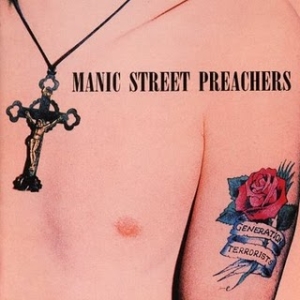

Whereas in the past, I've praised double albums/records with a high volume of content for managing to not to feel bloated, I cannot offer the same assessment for Generation Terrorists, the debut effort of the Manic Street Preachers. This album stinks of an overwrought need to cram songs into what was essentially a musical and political manifesto for the band, in a record where a song omission is effectively a censorship of stance. With a high media profile and long wait in the run-up to its much anticipated release, the band was set up for disappointment from the start. Thematically, the album is generally favoured, and the totality with which the Manics saturate its sound and lyrics with their message is undeniable. But the general consensus is that, despite the commendation, there's just too bloody much of it. And I'm inclined to agree.
  1. Motorcycle Emptiness
  2. Little Baby Nothing
  3. Slash 'n' Burn
  4. Nat West-Barclays-Midlands-Lloyds
  5. You Love Us
  6. Condemned To Rock 'n' Roll
  7. Tennessee
  8. Another Invented Disease
  9. Crucifix Kiss
  10. So Dead
  11. Methadone Pretty
  12. Spectators Of Suicide
  13. Love's Sweet Exile
  14. Stay Beautiful
  15. Born To End
  16. Damn Dog
  17. Repeat (UK)
  18. Repeat (Stars & Stripes)
Total Points: 49/90
Average Score: 5.44

A gargantuan eighteen individual songs, almost filling the entire 80 minute capacity of a compact disc, is an ambitious feat for your album debut, and something that hindsight would probably correct if it could. With retrospect comes a refined vision and a more discerning approach, and this was acknowledged by then rhythm guitarist and lyricist Richey Edwards, claiming it would be 'a lot better without the crap'. Daunting to tackle as a listener, the album largely matches expectation upon seeing the tracklist, as a dense and distended ordeal to trudge through. The fact that there are two versions of the same song (incidentally my least favourite song on the record) featured as part of official (non-bonus) album infrastructure indicates just how unnecessarily overpopulated the record is. That said, quality hardly comes into it - in fact, I found many of the tracks nearly impossible to distinguish in this respect (note the vast sea of middling yellow in my rankings). The real problem with Generation Terrorists is that, in sound at least, it's largely the same, more of the same, and then just a little bit more of the same. 

And then, there's Motorcycle Emptiness.

I've written previously about a standout single leaving the rest of the record in the dust, in reference to Cake by Trashcan Sinatras. To say this here would be a slight discredit to the overall quality achieved across Generation Terrorists, and the moderate strength of other reasonably memorable tracks like Slash'n'Burn and Condemned To Rock 'n' Roll. However, I cannot stress enough how fucking good this song is. In a sea of squiggly glam rock refrains and semi-screamed hair metal vocals set over cowbells and run-of-the-mill punk palm-muting, this is an absolute outlier. It doesn't compare - never mind the ballpark, it's a whole other game. It sounds nothing like anything else on the record, to the point where I'm thinking "is this even the same band?". Motorcycle Emptiness is a song that only should have surfaced with 2 or 3 albums under their belt, with the maturity and perspective that usually only comes with time and experimentation. Not on a debut, and not on a debut full to the brim with another very consistent flavour of music.

The instant the twisting, soaring notes of the guitar melody kick in, you're in a different world. The sparser drums and syncopated guitar strumming are so much more relaxed and effortless that it feels almost like autopilot; let the song do the work and the performance will take care of itself. No-one is trying too hard or in a hurry here - with the change of pace, you're given permission to close your eyes and absorb and enjoy as the 6 minutes of perfection drift into your ears. It feels like a dream - time transcends, and you're almost floating as the wondrous momentum propels itself, feeling at once wistful and voracious. Lyrically is the only way it ties into the rest of Generation Terrorists, with aptly critical themes of nihilism within capitalism; musically, however, it is untouchable. There's nothing wrong with the rest, style-wise. It's fine. It feels very within a mould, which is ironic for what is essentially a punk record. This is just a different kettle of fish, and it's for sure the kettle I want my fish from.

I can't really justify making time for most of the album. Little Baby Nothing deserves its flowers, and their cover of the M*A*S*H theme that features later as a bonus track is harrowingly heartfelt if repetitive, but Damn Dog, for example, can get in the bin. I'm not going to waste my time re-listening to or discussing the lowest tracks - why would I, when I could be listening to Motorcycle Emptiness instead? Sorry for being so dismissive, but that's just the power that Motorcycle Emptiness has over me. It is, and I don't use this word lightly, epic.


So, in summary:
  • Generation Terrorists is too long and bloated, but not necessarily bad.
  • The material is competently played but largely indistinctive.
  • Motorcycle Emptiness exists on a higher plain.
Come their next album (which I won't detail here, it may deserve its own dedicated post in the future), many of the 'issues' are fixed - the vision is much more focused and the execution far more easily digestible. But there'll never be another Motorcycle Emptiness which, quite frankly, marks the zenith of my interest in the Manics. Early demos reveal how it's an odd, ramshackle collage of other, far more punky cuts, and I find it utterly fascinating that such a young band were able to mould it into a masterpiece that sits so far apart from the rest of their repertoire. My overall score is not particularly favourable, but let it be known that it's far more a product of quantity over quality, and that the most quality article of all exists there within.

Monday, 22 July 2024

A New Morning (2002) - Suede

At the time of release, A New Morning was exactly that for Suede. The final product of a string of revelations, including a freshly sober frontman and an unforeseen need to replace the very guitarist who'd stepped in to fill Bernard Butler's shoes after Dog Man Star, the album would ultimately turn out to be a shift too far for Suede, and mark the end of their original run (bar a cursorily thrown together greatest hits the following year). In the liner notes of the 2011 expanded reissue, Brett Anderson reflects about the band wanting to "destroy their own myth" in creating the album, and by the 2018 documentary The Insatiable Ones has disowned A New Morning entirely, claiming it shouldn't have been made. There is a tangible bittersweetness between the album's beauty in simplicity and its unmistakable departure from direction. This wasn't what the public expected or, as it turned out, much wanted, from the band they thought they knew. But for me, there's a lot more to it than being a mere 'blot on the landscape', and I think it's important to examine A New Morning with the same fresh perspective with which it was created.


The conscious departure from the sticky, noise-congested sound that had gradually evolved throughout their previous four albums rings out from the very first song. Positivity exemplifies A New Morning's joie de vivre, a quality that Suede had left previously unexplored - the clear, chiming acoustic guitar a bright, eyes-open contrast to the twisted, electric distortion of Head Music. It tells the listener from the start that this will be an entirely new experience, and to the album's credit, the subsequent tracks follow suit, allowing sunlight to filter into the cracks that yesterday's Suede would have preferred clogged with grime. Gone are the city-immersed, jaded lyrics we've come to know, with Anderson now using natural phenomena has his primary muse; be it mentions of birds and fresh air or an ode to the magic of a rain shower, the essence of nature seeps its way into nearly every track and imbues them with life.

In a way, this refreshed perspective makes A New Morning the most 'alive' Suede release to date. No longer swathed in the influence of drugs and gritty urban surroundings, and unmarred by the dark, retrospective shadow of later, reformed Suede, this album is, to quote Untitled (a song that truly epitomises how I regard this album), a "wild flower grown through the concrete". With this vitality comes a focus on clarity, on seeing things plainly for what they are, and tracks like Lost In TV and Beautiful Loser are deadpan, disillusioned meditations on the heroin-chic, celebrity-obsessed lifestyle that Suede had previously represented and, to an extent, glamorised. The combination of these overt themes with uncomplicated lyrics of humble beauty and starkly transparent production gives A New Morning its own, unique strength. Though it may not be immediately apparent next to the rest of Suede's heavy-set electric-guitar-led projects, it has the power to stand alone as an overlooked marvel, achieving the very thing it celebrates in its content.

My rankings are as follows:
  1. Lost In TV
  2. Positivity
  3. Untitled
  4. Obsessions
  5. Streetlife
  6. When The Rain Falls
  7. Beautiful Loser
  8. ...Morning
  9. One Hit To The Body
  10. Astrogirl
  11. Lonely Girls
Total Points: 33/55
Average Score: 6.0

Though there are no 'blue'-rated tracks, the strongest are the ones I feel most effectively portray A New Morning's ease and clarity, and that really celebrate the charm in the mundane. Lost In TV, Positivity and Untitled are almost inseparable in quality because of how well they each exemplify the album's straightforward radiance. In all three, the vocals are the most direct and delicate, the lyrics pure and raw, and the production clear and emotive. None may have the 'bite' of an outstanding Suede hit, but this album, almost by design, shines better as a whole experience than by splitting apart its individual segments. This is why there are also no 'red'-rated tracks - it is a self-supporting ecosystem, where the stronger elements share their strength with the weaker ones, rather than lassoing the spotlight and allowing their inferiors to wither.

At its weakest, songs like Lonely Girls and One Hit To The Body feel limp and lacklustre - they're the ones I'll sometimes forget how they go until I press play on them, and they perhaps contribute the least to the album's worldbuilding, thematically inconsistent as well as a bit pedestrian in sound. I find the string arrangement in Lonely Girls particularly uninspired - though appropriately spritely at its core, it feels like a pale imitation of the much sweeter, rawer strings featured in Dog Man Star's hidden gem The Power, and the effect is superficial in an album full of honestly. Meanwhile, Astrogirl and When The Rain Falls both suffer a similar problem of being 'almost' there - they have such promising starts, the quirky and articulate introductions and verses possessing a rare magic that gives way to underwhelming choruses. Though both anticlimactic in this sense, When The Rain Falls is somewhat saved by its overall atmospheric resonance - even with a bit of a feeble chord resolution (if it can be called that), it still conveys its message sublimely and leaves a lasting impression. Even the spoken word outro evades the fate of second-hand embarrassment on the listener's part, which in itself is a true accolade!

At this point, it feels like a trademark of mine to ponder over the ifs and maybes of B-Sides and bonus tracks, but given Anderson's inclusion of his own revised tracklists in the booklets of Suede's expanded album remasters, I feel it is especially appropriate to mention how substitutions like Simon and Instant Sunshine could have raised the overall standard of A New Morning. Replacing the few duds with slightly more solid efforts, and perhaps a little shuffling around for pacing (though I generally enjoy the gentle rising and falling, especially waking up to ...Morning after the late-night revelation of Untitled) could have given the record a little more oomph - though I disagree with Anderson's take that Cheap is criminally ignored, coming across as far less of a bold proclamation than it blatantly aims for. 


However, even with these kind of tweaks, I don't think it would have changed A New Morning's fate. It was, and still is, the day to Suede's overwhelmingly prevalent night, and though these kind of alterations could easily have elevated the already fair critical acclaim a notch higher, I doubt they would have done much to sway listeners over to a new sound. I remember being bored to death the first time I listened to it, my expectations built up by their back catalogue, and the album coming across with all the personality of an early 2000's Ikea brochure in comparison. I felt like the band I liked so much for their virility and audacity had been neutered. But with each subsequent listen, I've acclimatised to A New Morning's universe, and I've realised this initial reaction (which, unfortunately, was all the majority of listeners at the time were willing to grant it) was based entirely on contrast. Its quality, emotional deliverance, and even song-writing are largely representative of the Suede I knew; I just had rediscover this in the light of a new day.

Monday, 8 July 2024

1977 (1996) - Ash

This is probably a bad habit, but I can't help but listen out for telltale signs of debuts being debuts. I'll press play and compare what I'm hearing to what I know, or what I'm aware the artist makes in the future; the path that lays ahead for them. In the case of Ash, one of the few acts I've seen live (I'm fully ready for the backlash when I say that I'm just not into live music), their first effort is largely a far cry from the kind of music that managed to drive me to actually buying tickets to their show many years later. In other words, in the years to come since making 1977, they would create incredible music. And this just isn't it. Let's get into why.


1977 has that kind of fuzzy, grey quality to it that brings to mind the Weezer classic Pinkerton - intentionally rough around the edges, unpolished and haphazardly human. All mistakes on purpose, it's simply a case of letting the feedback feedback and the noise noise. It's an aesthetic as much as it is a point being made, and it runs throughout. Finesse was not on the agenda, and I'm ok with this. My standout track, Goldfinger, shows how a masterfully constructed song can survive, or even thrive, with such muddy manifestation. It has just enough texture, with it's suspenseful sus 4s and time signature changes (come on music theory!) that it can carry itself regardless of potentially detrimental production choices. But honestly, the distinct way the instruments accompany the verses, the ritardando (I swear I never payed attention in music theory lessons!), and the idea of 'listening to the rain down in the basement' all just work for their sound during this era. Unfortunately, 1977 is not an album full of Goldfinger-quality writing and construction.
  1. Goldfinger
  2. Lost In You
  3. Kung Fu
  4. Angel Interceptor
  5. Girl From Mars
  6. Darkside Lightside
  7. I'd Give You Anything
  8. Oh Yeah
  9. Lose Control
  10. Gone The Dream
  11. Let It Flow
  12. Innocent Smile
Total Points: 29/60
Average Score: 4.83

Let's contrast Goldfinger with my lowest scorer, Innocent Smile. We're wading through the thickest of bogs with the audio here, distortion drowning everything including the vocals. Where Goldfinger has highs and lows, cliffhanging connections, stops and starts and effervescent drum fills to punctuate and open the song out from the fog, Innocent Smile... doesn't. What it does have is a gaussian blur of an ending that I honestly don't know how Ash was able to remember it well enough to rehearse and record it. As heard in one of the album's brighter moments, Kung Fu, band lead Tim Wheeler's signature verse style of syncopated monotone delivery in the chord's root note is also implemented, but without the quirkiness and the substance of the former. Bluntly put, this song is boring, and I feel that half the album (the oranges and reds, naturally) can best be described with that same blunt word.

Goldfinger acts as a glimmer of greatness and absolute mastery from a band that just hasn't quite got it yet. They're showing themselves capable, but can't do it on cue. Let's look at the augmented(? Music theory competence fading rapidly from view now) chord in Let It Flow's hook. We're at the second "It's calling out to me" and it feels like it's going to go somewhere interesting and resolve beautifully, in a salacious swerve reminiscent of Suede's early work. Instead, it cops out into the blandest following chord imaginable. It makes the music feel made sans dexterity and sans true effort, like they didn't know what they were doing and didn't strive to learn. And given that they were a young band, I think this may have been somewhat true. The resulting music is unmemorable and uninviting to replay. And, to bring things back to my initial observation, when combined with the muddiest of muddy production, it comes across as amateurish; sloppy and uninspired.

The string arrangements in Gone The Dream and Oh Yeah do serve as a demonstration of craftsmanship and ambition being invested into the songs. I don't personally think the effort was worth the payoff though, the songs themselves among the less interesting, and the addition of orchestral elements feeling an odd choice in such a noise-festooned album. One final criticism regarding Ash's junior status is how Wheeler implements his vocals. The soaring momentum in closing track Darkside Lightside suffers from a lack of dynamism is his voice. Once again, he shows himself capable of amping it up where needed and matching his delivery to the attitude of the music elsewhere on the album, but the penny doesn't seem to always drop, and his aloof 'run-through' of the words in this song flattens the impact it almost had.

Ash's talents shine best when they're really concentrating on resolving those chords satisfyingly and fighting the wash of genericness that threatens the entire album. Kung Fu's fantastical nostalgia-filled lyrics compliment the jungly central drum break and the neatness of the overall composition, making for a much-needed injection of personality into the proceedings. Lost In You, while the tiniest bit plodding, manages to follow through the tricks set up by the chords in the same vein as Goldfinger. Confidently performed and coherently rendered, this track has the competence and the understated elegance of a more established and self-actualised Ash that would present itself in future ballads in years to come.


This review may be less than favourable, but I don't really mean it as some kind of scathing attack on a first album - I'm not that much of a dickhead! Partially, I listened to the album and just had plenty to say - it stirred a lot of thoughts and opinions within me, and came as a neatly packaged solution to the writer's block I tend to suffer from. Otherwise, I think this review provides a good set-up for when I come back to Ash and review another one of their albums. I'll be able to recall what I wrote here and note the similarities and the differences, and I'm hoping it'll only serve to make the review that much stronger. It may have a low score from me, but Ash had to start somewhere. Though few and far between, 1977 has moments of greatness that signify even brighter sparks in the future, and I'm really looking forward to eventually getting round to them.

Wednesday, 3 November 2021

Bloodsports (2013) - Suede

When it comes to Suede, a band who I'd count myself as an actual fan of, choosing the first of their works to appraise is a tough call. Unlike most of the bands who have a selection of records I intend to cover, one of their albums is a single obvious standout for me, and I don't want to sing its praises only for the remainder of my Suede reviews to pale in comparison. Additionally, I don't want the restriction of going through them chronologically. So I've decided to start with an album I do like, that has undeniable virtue, but also marks a turning point for the band that tends to get overlooked. Writing this review is difficult, not because I don't have plenty to say on the matter, but because (again, unlike many musical outfits whose discographies I consider myself to be well-versed in) Suede's catalogue is, in my mind, directly comparable. Rating their albums together in one humongous essay would provide an easier structure for me to follow and probably be helpful in conveying the reasons for their rankings. But I'm not about to put anyone through that kind of slog.


After parting ways in 2003, 2013's Bloodsports is Suede's first release since reforming, and sees a return to their initial 'rock band' sound, having become a little less rock and a little more electronic with each of their first 5 studio albums. If this whole album was performed live, it would sound very similar to the recorded version, with no need for any instrument substitutions or special allowances. This return to roots is surely a conscious decision - probably an intentional ricochet off their 2002 flop A New Morning, which was full of sunny, squeaky-clean production - a perfectly valid direction, but nothing like how they began, and provenly unpopular with the listening public. Bloodsports first and foremost fills out the plastic shell Suede previously left behind with meat, in the form of thumping, resonant drums and assertive guitars. I'll get straight to the rankings so we can go into more detail:
  1. Hit Me
  2. It Starts And Ends With You
  3. Snowblind
  4. Sometimes I Feel I'll Float Away
  5. Barriers
  6. What Are You Not Telling Me?
  7. For The Strangers
  8. Faultlines
  9. Sabotage
  10. Always
Total Points: 29/50
Average Score: 5.8

My three highest-rated tracks are the epitome of this booming, confrontational sound. The opening bars of Hit Me are banged out at full force, the drums almost primitive in their boldness, and the chorus is equally thundering - a proclamation of the band's mettle, and a literal bait to the person at whom the lyrics are directed. Songs with this loud and proud approach are a wonderful counterpoint to the poetic, eclectic prose woven throughout the record. Whereas previous albums keep their thematic subjects broad and are talked about in a generalised, observational fashion, Bloodsports is very intimately written, with songs sung 'to' someone, not simply 'about' them. This allows for some beautiful turns of phrase, raw and delicate, and articulated in a way that frontman Brett Anderson simply could never achieve without this much more vulnerable and personalised approach. These elegant verses carry through to the quieter, more ethereal moments too, which help break up what could otherwise be a rather dense procession. The most notable instance of this is the softly haunting Sometimes I Feel I'll Float Away, which speaks of the addressee's 'impossible eyes' and 'hairpin bends', elegantly characterising the kind of tension often present in the most complex emotional relationships.

One thing I do find fault with is that Bloodsports marks the first time the band takes a real turn for the dour. It's been an ongoing issue since their reunion - thankfully Bloodsports manages to retain some of their former spunk, but all the seeds of their current aura of gloom are planted within. There's such a tangible inclination now growing towards thick smogs of guitar and drawling, ominous vocals. Percussion begins to favour atmospheric punctuation rather than actual rhythm, and the vivid, sweet-and-sour swagger of 90s Suede is starting to give way to a funereal, grey rigidity. The biggest contributor to this is the change in how chords are utilised - before, there was such an interesting push and pull of major and minor, with chord progressions twisting like smirks and leaving you tantalised for the unexpected. Now, Suede errs increasingly towards the minor, and the chord sequences play like dirges, without sufficient yang to counter the yin. Luckily only a handful of tracks from Bloodsports suffer this fate but, come the next album, a whole host of songs are largely minor affairs, unseasoned with tangy inflections or the odd surprise. I'm no musical theorist, but this just means I can't accurately name what I'm identifying - you don't need to be a scholar to recognise when music loses its colour.

This blaring dichotomy between before and after hiatus is so strange to me. They're still Suede - they still sound like the same band - but it's like they've grown up. Physically, they have, of course, but Suede were never exactly immature to begin with. They always represented a knowing, outsider voice among the everyman's Britpop. If Britpop is a family, with Blur and Oasis as boisterous, competitive brothers, I like to think of Suede as the black sheep, that distant, estranged second cousin. They're more alternative, more in tune with the underground, and more worldly. No, this gloom isn't simply Suede growing older, they're also growing colder. The unrelentingly dreary Sabotage is the worst culprit, while Always makes an attempt at harking back to the edgier contours present in Dog Man Star, but unsuccessfully so, instead coming across unbearably listless. After Bloodsports, my interest in their studio output unfortunately wanes, as both of its successors continue to perpetuate their trajectory into bleakness.


I realise I'm now making Bloodsports out to be some kind of leaden requiem, but this is not the case. As I noted, the seeds of apparent sullenness are planted, but the forest is yet to grow. There's still plenty of life present, and the album does a lot to marry the best of Suede's various eras together. It may not have the hedonistic, youthful charisma of prior works, but it has such a bold and determined presence, and demonstrates incredible sensitivity and capability. It has a kind of competence that comes only to veteran artists, and they manage to tap, with expert dexterity, into so many of the impalpable characteristics that made them such a left-field powerhouse in the Britpop heyday. This alone shows that they never lost anything, they've just evolved, and continue to do so. I like to think of each Suede record as a stamp on an ever-growing timeline, and Bloodsports, though the beginning of a shift I don't necessarily respond to, represents a fulcrum in the band's sound that would be impossible anywhere else in time. Essentially, the best way to enjoy Bloodsports is to ignore the past and refrain from peering forward. Only when you blinker yourself this way can you become absorbed enough to appreciate it for what it is, without the contextual distractions that are, ultimately, the album's only real detractor.