Friday, 26 December 2025

Generation Terrorists (1992) - Manic Street Preachers

I usually try to write my reviews in a way that 'comes full circle' or reinforces my main observations/talking points, so that they feel as complete as I can make them. During the course of writing this one though, I realised that each of those points were merely a station on a rather linear route - all needed, all wanted, but without an all-encompassing message I'm trying to convey. And the culmination is ultimately an ode to perhaps the greatest song of the 1990s, rather than a reflection of the whole album. So - spoiler alert - this one is going to end with a weird science-project-esque points summary as a kind of round-up, but no actual general conclusion. No problem there, but maybe not what you'd usually expect from me in terms of structure. In terms of polarising opinions and florid language, however, I shouldn't expect to disappoint.
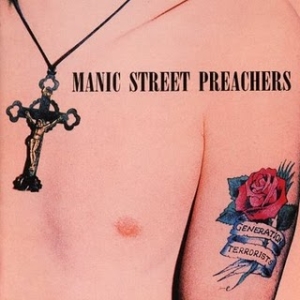

Whereas in the past, I've praised double albums/records with a high volume of content for managing to not to feel bloated, I cannot offer the same assessment for Generation Terrorists, the debut effort of the Manic Street Preachers. This album stinks of an overwrought need to cram songs into what was essentially a musical and political manifesto for the band, in a record where a song omission is effectively a censorship of stance. With a high media profile and long wait in the run-up to its much anticipated release, the band was set up for disappointment from the start. Thematically, the album is generally favoured, and the totality with which the Manics saturate its sound and lyrics with their message is undeniable. But the general consensus is that, despite the commendation, there's just too bloody much of it. And I'm inclined to agree.
  1. Motorcycle Emptiness
  2. Little Baby Nothing
  3. Slash 'n' Burn
  4. Nat West-Barclays-Midlands-Lloyds
  5. You Love Us
  6. Condemned To Rock 'n' Roll
  7. Tennessee
  8. Another Invented Disease
  9. Crucifix Kiss
  10. So Dead
  11. Methadone Pretty
  12. Spectators Of Suicide
  13. Love's Sweet Exile
  14. Stay Beautiful
  15. Born To End
  16. Damn Dog
  17. Repeat (UK)
  18. Repeat (Stars & Stripes)
Total Points: 49/90
Average Score: 5.44

A gargantuan eighteen individual songs, almost filling the entire 80 minute capacity of a compact disc, is an ambitious feat for your album debut, and something that hindsight would probably correct if it could. With retrospect comes a refined vision and a more discerning approach, and this was acknowledged by then rhythm guitarist and lyricist Richey Edwards, claiming it would be 'a lot better without the crap'. Daunting to tackle as a listener, the album largely matches expectation upon seeing the tracklist, as a dense and distended ordeal to trudge through. The fact that there are two versions of the same song (incidentally my least favourite song on the record) featured as part of official (non-bonus) album infrastructure indicates just how unnecessarily overpopulated the record is. That said, quality hardly comes into it - in fact, I found many of the tracks nearly impossible to distinguish in this respect (note the vast sea of middling yellow in my rankings). The real problem with Generation Terrorists is that, in sound at least, it's largely the same, more of the same, and then just a little bit more of the same. 

And then, there's Motorcycle Emptiness.

I've written previously about a standout single leaving the rest of the record in the dust, in reference to Cake by Trashcan Sinatras. To say this here would be a slight discredit to the overall quality achieved across Generation Terrorists, and the moderate strength of other reasonably memorable tracks like Slash'n'Burn and Condemned To Rock 'n' Roll. However, I cannot stress enough how fucking good this song is. In a sea of squiggly glam rock refrains and semi-screamed hair metal vocals set over cowbells and run-of-the-mill punk palm-muting, this is an absolute outlier. It doesn't compare - never mind the ballpark, it's a whole other game. It sounds nothing like anything else on the record, to the point where I'm thinking "is this even the same band?". Motorcycle Emptiness is a song that only should have surfaced with 2 or 3 albums under their belt, with the maturity and perspective that usually only comes with time and experimentation. Not on a debut, and not on a debut full to the brim with another very consistent flavour of music.

The instant the twisting, soaring notes of the guitar melody kick in, you're in a different world. The sparser drums and syncopated guitar strumming are so much more relaxed and effortless that it feels almost like autopilot; let the song do the work and the performance will take care of itself. No-one is trying too hard or in a hurry here - with the change of pace, you're given permission to close your eyes and absorb and enjoy as the 6 minutes of perfection drift into your ears. It feels like a dream - time transcends, and you're almost floating as the wondrous momentum propels itself, feeling at once wistful and voracious. Lyrically is the only way it ties into the rest of Generation Terrorists, with aptly critical themes of nihilism within capitalism; musically, however, it is untouchable. There's nothing wrong with the rest, style-wise. It's fine. It feels very within a mould, which is ironic for what is essentially a punk record. This is just a different kettle of fish, and it's for sure the kettle I want my fish from.

I can't really justify making time for most of the album. Little Baby Nothing deserves its flowers, and their cover of the M*A*S*H theme that features later as a bonus track is harrowingly heartfelt if repetitive, but Damn Dog, for example, can get in the bin. I'm not going to waste my time re-listening to or discussing the lowest tracks - why would I, when I could be listening to Motorcycle Emptiness instead? Sorry for being so dismissive, but that's just the power that Motorcycle Emptiness has over me. It is, and I don't use this word lightly, epic.


So, in summary:
  • Generation Terrorists is too long and bloated, but not necessarily bad.
  • The material is competently played but largely indistinctive.
  • Motorcycle Emptiness exists on a higher plain.
Come their next album (which I won't detail here, it may deserve its own dedicated post in the future), many of the 'issues' are fixed - the vision is much more focused and the execution far more easily digestible. But there'll never be another Motorcycle Emptiness which, quite frankly, marks the zenith of my interest in the Manics. Early demos reveal how it's an odd, ramshackle collage of other, far more punky cuts, and I find it utterly fascinating that such a young band were able to mould it into a masterpiece that sits so far apart from the rest of their repertoire. My overall score is not particularly favourable, but let it be known that it's far more a product of quantity over quality, and that the most quality article of all exists there within.

Thursday, 18 December 2025

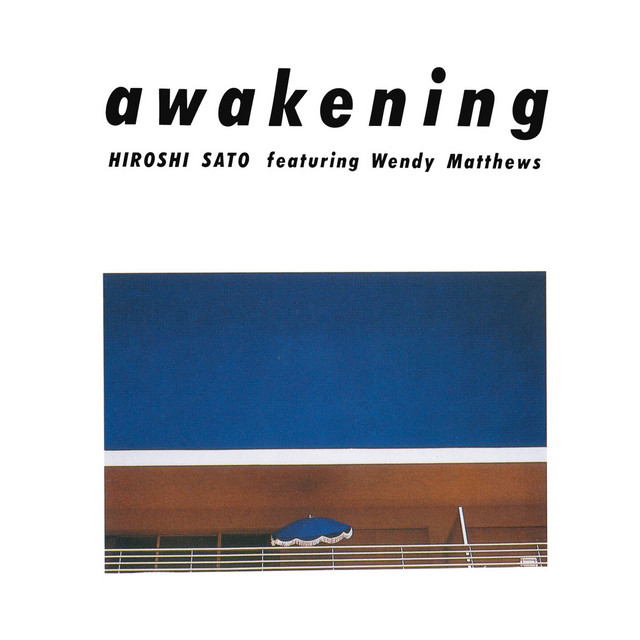
Awakening (1982) - Hiroshi Sato featuring Wendy Matthews

Hiroshi Sato was part of the City Pop scene since its inception, but I never see him attributed with the same prestige or influence as the likes of Tatsuro Yamashita or Toshiki Kadomatsu. That said, his landmark album, 1982's Awakening, is about as classic a City Pop record as one could imagine, but in a far quirkier, organic and individual way than what could be expected from most other artists. Vastly ahead of its time, this work is an unlikely product of Sato's yearning for something he felt Japan could no longer afford him and a magnetism that continually drew him back to his musical roots. To Sato, it really was an awakening, because it represented a renewal of possibility, and the resulting work is one of the finest examples of genre fusion to come out of Japan that decade.

Long-time readers of this blog (who?) will know the value I place on an album with a succinct flavour, whose songs exist as part of a self-contained ecosystem. Awakening is very much one of these albums, but in such an imaginative and unusual way that fuses ideologies and tech to create something quite unique. At one end of the spectrum, there exist within the record slow, after-midnight, smoky jazz-club ballads, full of soul and emotion, centred around the acoustic piano. At the other end, we have the hyper-futurism of the Roland Jupiter 8 and the Linn LM-1 drum machine (I know, I know) which feel to be at the very frontier of music production, sounding almost otherworldly, let alone innovative. Such a fusion shouldn't work, but it's to Sato's credit that he had such inspiration and vision with this record, that he seemed to just make them work. The blend is inexplicably effortless. Even that drum machine, when incorporated with flush production value, choice timbre and carefully monitored accompaniment, can be part of a truly stylish, palatable yet avant-garde soundscape.*

*I maintain that Prince had no place using it in Sign 'O' The Times, feeling more of a convenience in his case, whereas for Hiroshi Sato it feels integral to his overall concept.

  1. Say Goodbye
  2. Blue And Moody Music (Wendy's Version)
  3. Only A Love Affair
  4. Blue And Moody Music
  5. Awakening
  6. It Isn't Easy
  7. I Can't Wait
  8. Love And Peace
  9. You're My Baby
  10. From Me To You
    (Exempt from total score: Awakening (覚醒) )
Total Points: 30/50
Average Score: 6.0

Say Goodbye is about as close to a City Pop anthem as you can get, yet its sound actually encroaches more on the contemporary 'future-funk' offshoot from the last decade. Though the staple of funky guitar fills are prevalent, as well as Awakening's signature semi-automated arpeggiated motif, it's the introduction of Sato's robotic vocoder-processed voice and the wobbly low synths that project this song so far into the future. This combination makes for a distorted, submerged-under-water feel that evokes the kind of overproduction that has only really come about since City Pop was rediscovered in the internet age, messing with its bare bones and 'retrofuturising' the music within a new context. Here, the heavy affectation to the tones create a bubble around the relatively simple song, making it the most immersive moment on the record.

Collaborating with Australian singer Wendy Matthews for multiple vocal tracks was a key factor in the album's blanket mood of genre-mashed sophistication. Her clear, high voice performs a careful balancing act with Sato's deep, rich tone, and the whole album feels like the most grown-up of duets. Their two separate versions of Blue And Moody Music act as opposing ends of the electronic-acoustic spectrum - and though both are magnificent, the rendition with Wendy's vocals trumps it for me; the brighter, perkier sound bypasses the literal content of the lyrics and cuts straight to the feeling they're trying to convey. Her voice is an exquisite fit for another highlight, Only A Love Affair, in which she passionately but sagaciously confesses her irrepressible love for someone, as the coolest of electric pianos tinkles around her vocals. The song is restrained, chic and perhaps the most refined on the album, whilst still feeling very much part of the same world as the thick, competing layers of Say Goodbye.

Though it's true that I applaud how effectively Sato was able to marry acoustic jazz with pioneering electronica, I will say that every track errs one way more than the other, and it is unfortunately those jazzier influenced ballads that I feel are weaker. They are undoubtedly beautiful in their moodiness, but that moodiness is a double-edged sword; at worst, they're sluggish, dense and drowsy. It Isn't Easy, when isolated, manages to ride the soul to a greater degree of success than the rest, but is mildly hampered by its positioning directly after the equally-slowly-paced I Can't Wait. Furthermore, its aloofly virtuoso piano solo is offset by the overarching prevalence of a particularly lumpy pentatonic scale motif, feeling a little too remedial of a focus when in such a high class of music production.

While City Pop contemporary Tatsuro Yamashita (who, incidentally, plays guitar throughout Awakening) is obsessed with the Beach Boys, Hiroshi Sato always had something of a hyper-fixation with another western entity - The Beatles. Barely an album surfaced without a slightly awkward cover of one of their more overlooked songs, their original 60's sound rejected in favour of synthesisers and clunky 16-beat rhythms, attempting to update them for the 1980's. Sato always had great melodic and harmonic instincts, a vivid imagination and an excellent grasp of the English language; by this logic, these covers shouldn't be ill-advised disasters. Unfortunately though, these strengths are hard-countered by a frequent lack of restraint, a desire to constantly push the envelope, and a preoccupation with unnecessarily reworking old material (others' and his own alike). The results were often shambolic arrangements full of mad, goofy-sounding synth sounds, that stink of trying to fix something that isn't broken. From Me To You is no exception, sounding rather like a demo playing out of a Casio midi keyboard. Its slowed-down pace renders the music patchy and insubstantial, and the poor choice of song turns the sophisticated and modern vibe from the rest of the album utterly on its head, this track absolutely lacking synergy with the rest of the material.


The aforementioned envelope pushing is perhaps the reason why I don't harbour as much love for Sato's subsequent works, which are far more synth-heavy and clumsy, despite his ever-prevalent skilfulness as a programmer and producer. Awakening marks an interesting juncture in his career, freshly back from America (a point of significance for many City Pop artists), increasingly interested in where technology could take him and the boundaries it would broaden, but still wanting to scratch an itch that existed from a time where his music was more atmospheric and acoustic. It is this in-between-ness that perhaps makes this album such a standout, not just to myself but in the general view of City Pop connoisseurs. Marriage of cultures and genres has always been elemental to City Pop, but never has it been quite so exploratory and to such serendipitous effect. There is, quite simply, nothing else like it.